< Sascha Pohle,Peter Weibel,Kim Yun-shin >
2023.04.26
Seunghee You
Seunghee You
By visiting three exhibitions in a single day, I was once again reminded that contemporaneity is an age of pluralization. My itinerary—traveling through Jongno-gu, Mapo-gu, and Gwanak-gu to see three solo exhibitions—was nothing more than an ordinary sequence of activities carried out within the city of Seoul. Yet within this seemingly mundane routine was embedded the image of a contemporary society that is convergent, porous, and global.
Germany, the United States, Austria, Spain, the Netherlands, Korea, France, Argentina, and Brazil—these are the countries in which the three artists whose exhibitions I saw today have lived and worked. The contemporary can no longer be contained within a single framework or narrative. Just as the dictionary definition of pluralization refers to “an increase in the number of origins that constitute a thing,” the origins of individuals have likewise become increasingly diverse and dispersed.
To add a personal anecdote: when I finally visited the Guggenheim Museum in New York—a place I had long dreamed of seeing—I happened to find a book by an artist I deeply admire and purchased it on the spot. Perhaps because I bought it at the Guggenheim after a fourteen-hour flight, the book felt especially meaningful. However, upon returning home, I discovered the exact same book readily available on Coupang. In that brief moment, the sense of having obtained something uniquely special shifted dramatically into disappointment. I found myself thinking, with both pleasure and bitterness, that experiences which once felt rare and exceptional have now become easily accessible to people living in the contemporary moment.
Returning to the exhibitions, I found myself questioning whether, in this exceptional era that allows us to peer into such a wide range of thoughts and perspectives—those of Peter Weibel, Sascha Pohle, and Kim Yunshin—we are truly embracing this diversity in its entirety, rather than selectively consuming it.
Max Horkheimer (1895–1973) and Theodor W. Adorno (1903–1969), in Dialectic of Enlightenment, argue that enlightenment—originally intended as a means of liberating humanity from the mythic forces of nature—has paradoxically regressed into myth and barbarism once again. Through enlightenment, humanity may have escaped its primordial state of subjugation to nature, but in the process of becoming civilized, it became re-enslaved to another form of barbarism: totalitarianism. Whether through overt dictatorship or refined democratic systems of control, individuals within totalitarian mechanisms fail to establish themselves as rational and autonomous subjects, instead reverting to objects of domination and violence.
Such totalitarian tendencies are also evident in today’s social networking service (SNS) culture. This was particularly apparent at the Peter Weibel exhibition at the National Museum of Modern and Contemporary Art, which attracted an overwhelmingly young audience. While viewers appeared to be standing in front of artworks and engaging with them, there were constantly others nearby taking photos of them. As a result, when searching for #PeterWeibel on Instagram, one finds an abundance of images featuring people posing with the artworks. The exhibition is thus more likely to be remembered as a place where visitors captured images of themselves within the screen, rather than as an encounter with the intellectual substance of Weibel’s work.
In Observing Observation: Uncertainty, cameras are installed in a circular formation, and when a viewer stands at the center, their image is projected onto monitors in real time. No matter how the viewer moves, they are unable to see what they wish to see directly; instead, they are confronted only with their mediated image on the screen. Although Weibel intended this work to reveal the limitations of human perspective and perception, I experienced it instead as a demonstration of how the vast perceptual potential of humans is constrained by machines. The sight of visitors photographing the monitor displaying their own image—an act that was nearly universal—evoked for me a vision of contemporary totalitarianism, in which freedom is paradoxically suppressed by the immense power of technology.
Ultimately, this exhibition prompted a reconsideration of the relationship between humans and technology, particularly the tendency to accept technology in an uncritical, almost obscurantist manner.

Installation view of Peter Weibel: Art as Cognitive Action,
visitors taking photographs of themselves in front of Observing Observation: Uncertainty.
Source: Google Images
visitors taking photographs of themselves in front of Observing Observation: Uncertainty.
Source: Google Images

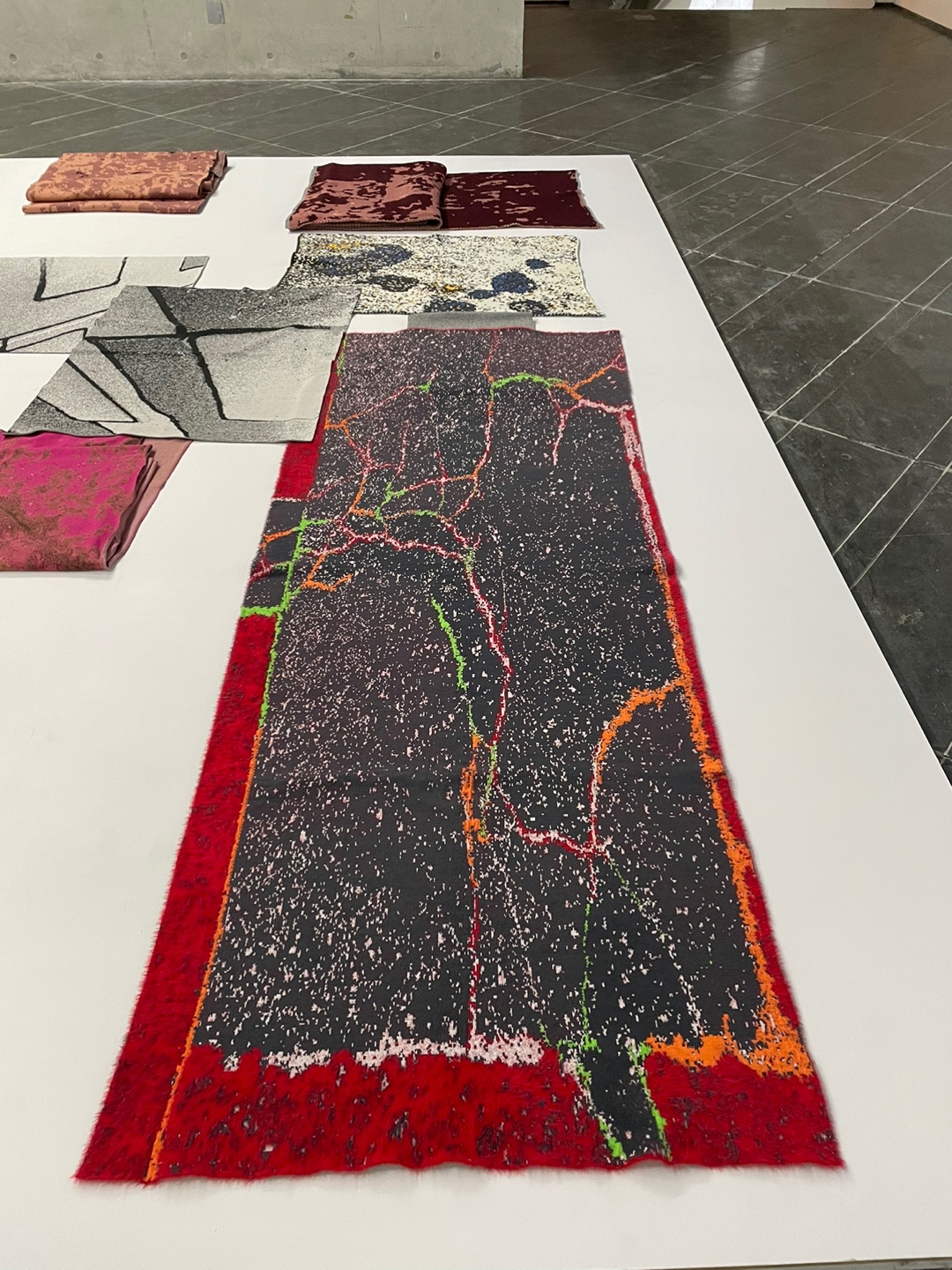


Exhibition view of Sascha Pohle: Fluid Ground, photo by the author.
As seen in the image above, Sascha Pohle is an artist who works with everyday objects. Using materials such as glass, knitted textiles, mesh bags, and Styrofoam buoys collected along the Incheon coastline, she draws out traces of social and historical meaning embedded in ordinary things. Through these materials, her work fluidly traverses boundaries—between the public and the private, citizens and foreigners, the micro and the macro—inviting viewers to confront meanings that have permeated everyday life.
Based between Seoul and Amsterdam after living in Germany, Sascha Pohle addresses the persistent dynamics of acceptance and exclusion between nationals and non-nationals that continue to exist amid repeated migration and temporary settlement. These issues are articulated in the work Regardless of Nationality. In Passage, she weaves the uneven, time-worn surfaces of urban ground into soft knitted textiles. She then performs an action of unfolding and layering these textiles, each depicting different cities.
As suggested by the exhibition title Fluid Ground, the contemporary world appears to possess a fluid surface. Yet uncomfortable forms of discrimination between nationals and foreigners remain firmly structured beneath it. Just as meticulously planned and perfectly constructed cities are inevitably damaged over time, contemporaneity, though seemingly fluid, is not entirely so. At the same time, artists like Sascha Pohle respond to this reality by prompting closer examination of what is often overlooked or passed by unconsciously. In doing so, they create moments that invite viewers to pause and engage in critical reflection. In this sense, the contemporary condition cannot be described as entirely rigid either.
This tension may explain the “pleasant yet bitter” emotion I felt in the Guggenheim episode mentioned earlier. Referring to the “coexistence–empathy” section of Porous Art¹, contemporary art has long aestheticized participatory forms of human relationships by contemporizing both empathy and coexistence. In other words, art functions as a means for coexistence, and for humans, the meanings of coexistence and empathy remain essential elements.
Network theorist Bruno Latour argues that, contrary to the common belief that as science and technology “advance,” our “direct contact with objects disappears,” the relationship between humans and things has in fact become “far more intimate.”² In this sense, the frighteningly rapid development of technology can paradoxically offer deeper and more profound reflections on what it means to be human.


Regardless of Nationality, photo by the author.
In contrast to Sascha Pohle, who works across a wide range of media, Kim Yunshin has devoted nearly fifty years to wood sculpture. Adding and Dividing, Becoming One, currently on view at the SeMA Nam-Seoul Museum of Art, was an exhibition that conveyed a sense of purity and solid depth rarely encountered in the diverse and highly stimulating works of the contemporary moment.
Kim Yunshin’s practice embodies not only a persistent dedication to a single medium, cultivated through decades of sustained inquiry, but also her distinctive philosophical principle of Habi Habil, Buni Bunil (合二合一 分二分一). This concept, which consistently underlies her work, is derived from the yin–yang philosophy that understands all things in the universe as repeatedly undergoing cycles of generation and dissolution. Kim reinterprets this principle in her own way, giving it sculptural form through wood.

Habi Habil, Buni Bunil (合二合一 分二分一), wood sculpture by Kim Yunshin, photograph by the author.
Kim Yunshin regards art as a spatial art. For this reason, she carves by creating spaces in between a single log—opening intervals, gaps, and pauses within the material itself. Remarkably, as space emerges, a single sculpture appears to divide into multiple parts, yet these fragments are reconnected through the very spaces that separate them.
Kim is said to spend a long time gazing at the wood before beginning her work. Only when she becomes the wood and the wood becomes her does the process truly begin. In a contemporary moment in which far more time is spent staring at screens, Kim Yunshin’s act of “gazing at wood” may feel like an unfamiliar gesture. It recalls the image of my niece—barely twenty-two months old—absorbed by dazzling moving images, a scene that quietly underscores the contrast between modes of attention in our time.

Gazing at wood—living a life of working in unity with it. For nearly fifty years, Kim Yunshin has chosen to become one with the solidity of wood, and through her works she demonstrates how a singular philosophy can contain infinite meanings. Having viewed the exhibition by Peter Weibel, which addresses the limits of human perception, the value of singularity embedded in Kim Yunshin’s work resonated even more strongly.
In Weibel’s works, one’s movements are detected by sensors and cameras and projected in real time onto screens, yet it is difficult to truly sense oneself within those images. The fragmented and dazzling multiplicity of one’s own moving figure becomes an obstruction. By contrast, Kim Yunshin’s sculptures remain still, quietly occupying their place. And yet, in this stillness, the vitality of the artist’s touch is vividly felt. Forms that appear to merge and divide, and the way the works interact reciprocally with their surrounding space—such as sunlight filtering through a rear window—generate new possibilities of imagination.
In an interview video, Kim Yunshin encourages viewers to approach her works through their own perceptions, inviting them to become one with the sculpture, just as she becomes the wood and the wood becomes her.

Video still from the artist interview, recorded by the author.

The artist’s work and the author prior to becoming one with it, photograph by the author.
The three exhibitions can be broadly categorized according to three positions: one that actively embraces technology, one that situates itself between technology and the human, and one that remains distant from technology altogether. There is no criterion by which to judge which of these positions is right or wrong. Rather, by considering the three distinct perspectives, this became a moment to gradually and intuitively discern the direction of one’s own sensibility. Beyond individual preference, it also provided an opportunity to understand the pluralization, porosity, and convergence that characterize contemporaneity.
Adorno argued that true art does not reside in a totality that subsumes affirmation and negation into a single concept, but rather emerges when “coexistence” becomes possible—when multiple beings are acknowledged as they are. Recognition and respect that arise merely from following what others do, or from being swept along by prevailing social atmospheres, remain incomplete, and thus cannot produce the coexistence Adorno envisioned. Genuine art begins with the sincere acknowledgment of multiplicity. Therefore, if the meaning of pluralization in contemporaneity is not to be distorted, greater attention must be paid to what is new or unfamiliar, while it may be necessary to take distance from what is already familiar or deeply absorbed.
¹ Sumi Kang, Porous Art: Performative Communication Structures and Social Networking in Korean Contemporary Art (Seoul: Geulhangari, 2017), 73.
² Bruno Latour, Bruno Latour’s Letters on Science and the Humanities, trans. Lee Sejin (Seoul: Saworui Chaek, 2012), 74.